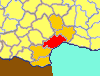
Political Geography of the Languedoc: The département
of the Gard ( Gard):
The Camargue (Occitan
Camargo, Occitan Provençal: Camarga)
The
Camargue is a triangular area lying on the coast between
the Languedoc-Roussillon
and Provence. It is a river delta where the Rhône
meets the sea - a marshy island bounded by two branches
of the Rhône
and the Mediterranean
Sea. With an area of over 930 km² (360 sq. miles),
the Camargue is western Europe's largest river delta, with
exceptional biological diversity, and home to unique breeds
of Camargue
Horses and Camargue
Bulls, and to more than 400 species of birds including
Pink
Flamingoes.
Much of the area is under water - inland salt water
lakes, called étangs
in the Languedoc. Approximately a third of the Camargue
is either lakes or marshland. The largest of these
salt water lakes is the The
Étang de Vaccarès. Established as
a national park and nature reserve in 1972, the Parc
Régional de Camargue covers 820 km²
including some of the wildest and most protected in
Europe. It is a major world heritage wetland. A roadside
museum provides background on flora, fauna, and the
history of the area.
In all, the Camargue covers around 140,000 hectares,
including wetlands, pastures, dunes and salt flats.
The
Camargue is home to a specialised breed of bull. These bulls
run in semi-liberty. They are noticeably smaller that most
modern breeds of bull.
They
are raised for their distinctive meat which has a high reputation
among gourmets. It is served in local dishes and in stews.
Bulls are also used in a form of bull running, during which
young men called razeteurs try to pick a cockade fixed between
the horns of a running bull. The bravest bulls are not killed.
In fact very bravest of them warrant their own statues. This
kind of bullrunning dates back to the Sixteenth century at
least.
A manade (Provençal manado) is a free running
group of bulls, cows or horses managed by a gardian, in the
Camargue. The manade is directed by a manadier (or baile
in Provençal).
There are three sorts of wild bull in the Camargue::
Pure Camargue bulls which run free, and are used for the
"course provençale" or the "course
à la cocarde".
Bulls crossed between Camargue and Spanish bulls destined
for the "capeas" or the "corridas économiques".
Pure Spanish or Portuguese bulls destined for formal "corridas".
Among the best known manades are those of Hubert Yonnet,
Lucien Tardieu, Pourquier, and François André..
The manades are principlly in the Crau, or the Petite Camargue.
The word manade was in ealier times also used for flocks
of sheep.
Camargue horses
Camargue
horses form distinct breed, which, like the Camargue bulls,
live in semi-liberty.The Camargue
is one of the oldest breeds in the world, closely related
to the prehistoric horses whose remains have been found elsewhere
in southern France. At birth they are coloured dark brown
or black, but turn white around the fourth year (In layman's
terms they are white horses, but to horsy folk they are grey,
since they are not uniformly pure white all over).
Like the Camargue bulls, Camargue
horses are smaller than their modern cousins. At around
thirteen or fourteen hands they are technically ponies. They
are used in rounding up Camargue bulls. They are never stabled,
but well able to survive the humid summer heat and the biting
winter cold.
Riders
are called gardians. Gardians are as near to anyone comes
nowadays to living the cowboy way of life. They play a major
role in guarding Camarguais traditions. They live in traditional
cabanes, thatched and windowless single-storey structures
furnished with bulls' horns over the door to ward off evil
spirits. A guardian's traditional tools are a trident and
a black hat.
The
Camargue the only place in France (and one of the few anywhere
around the Mediterranean) where pink flamingos nest. The flamingo
population can reach 20,000 couples grouped into flocks. They
favour raised nests built out of mud.
Flamingoes
eat mainly plankton, and are adapted to do so - much like
baleen whales: they suck water in through their bills and
expel it over fine filters in their mouths straining the plankton.
It is this plankton, not as sometimes claimed crustacea, that
are responsible for the flamingo's pink plumage.
The flamingo is the emblem of Camargue - a modern wheeze
to appeal to tourists.
Other Animals.
Other Camarguese animals include sheep, wild boar, beavers,
badgers; tree frogs, water snakes, pond turtles, along with
a rich array of some 400 types of bird, some of which are
mentioned below.
Camargue Weather.
The
climate of the Camargue can be harsh, ranging from scorching
heat in summer, sometimes with 100% humidity, to desiccating
cold whipped by icy winds from the Alps in winter.
The area is also subject to the famous Mistral
wind. blowing from the north- north-west down the Rhône
Valley
Camargue Ecology
An
area covering 85,000 hectares of the Camargue was designated
as a nature reserve in 1927. This area was granted National
Park status in 1970. Efforts are now made to maintain the
fragile equilibrium between the indigenous ecosystems on the
one hand and human activities (tourism, agriculture, industry
and hunting) on the other.
The north of the Camargue is mainly agricultural land. Main
crops are cereals, grapevines and rice.
The centre and south of Camargue is a more natural area,
characterised by a brackish saline ecosystem. Flora of the
Camargue is adapted to these conditions. Sea lavender and
glasswort flourish along with tamarisks, reeds, juniper trees,
wild irises wild rosemary. The juniper trees growing to a
height of 6m form the woodland on the islands between the
Étang du Vaccarès and the sea (Bois des Rièges).
The
étangs. These salt water lagoons are surrounded
by sand dunes. Originally sculpted by the wind they are now
man-made - at least around Salin-de-Giraud. They are where
salt is produced - dried by the sun and wind in immense spaces
called "salins". This salt was a source of great
wealth for the so-called "salt abbeys" of Ulmet
and Psalmody in the Middle Ages. The salt industry started
up again in the nineteenth century and big chemicals companies
founded the salt extraction city of Salin-de-Giraud. Today,
evaporation pans at Salin-de-Giraud - the largest in Europe
- extend over 11,000 hectares and produce some 1,000,000 metric
tons a year, Sodium and chlorine from the salt are used in
many chemicals and pharmaceuticals. Low-lying salt plains
(sansouires) dry out and crack in summer. They are carpeted
with glasswort (grazed by the wild bulls and Camargue horses).
These plains are submerged in winter but in the spring they
re-emerge as wetlands for marsh birds such as black-winged
stilts, godwits, and sandpipers.
The
Étang de Vaccarès. This is the largest of
the étangs, surrounded by reeds and sansouires. It
is a large body of water extending 6 000 hectares (23 sq.
miles) and is central to the water control system of the delta.
It receives water from three main canals constructed to drain
off the minor lagoons. It is is less than 2 meters deep.
Water that used to come from regular flooding of the River
Rhône (before a sea dike was built). Today it collects
the runoff from the surrounding rice paddies. Its exposure
to sun and wind make it an efficient water purification system.
Here you will find coots, diving ducks and fishing birds such
as grebes, terns, seagulls, and those famous pink flamingos.
Other Ponds and marshes cover a large part of the river delta.
Marshes are subject to the vagaries of the Mediteranean
Climate and may dry up in summer. Ponds are the habitats
of choice for migratory and sedentary birds including egrets,
night herons, bitterns, mallards and wagtails. They are also
home to innumerable insects, including the most ferocious
mosquitoes to be found in France.
The
Sea Dike. A dike was built in the nineteenth century to
contain the delta, and prevent flooding by incoming sea water.
This digue à la mer (dyke of the Sea) is about 20 km
long. On the east it borders some of the Salin-de-Giraud salt
farms. To the west beyond dunes are stabilised by chestnut
wood palisades to retain the sand ("ganivelles").
They have their own specialised flora including marram grass,
sand lily, dog's tooth, and spurge). The area attracts sterns,
avocets, kentish plovers and of course of seagulls).
Camargue Woodlands. Woodland
accounts for a small part of Camargue physically, but plays
an important part in the balance of nature. Woodlands lie
along the River
Rhône and on sand dunes south of Vaccarès.
Wooded areas provide habitat for many mammals, including rodents,
foxes, and wild boar; and insects which attract nesting birds
such as little egrets and night herons.
There are also rice paddies and vineyards.
Physical Geography of the Camargue
Approximate coordinates 43°32'N 4°30'E .
The
Camargue has a coastline some 30 miles in length and an area
of 290 sq. m., of which about a quarter consists of cultivated
fertile land. Its average elevation is from 8 ft to 62 feet
above sea level. Some of the étangs are remnants of
old arms of the river (Remember those oxbow lakes from school
geography lessons?). Flooding remains a "problem"
across the region. Despite the dikes and embankments, the
boundaries of the Camargue are still changed by the River
Rhône as it transports huge quantities of silt and
mud downstream - some 20 million cubic metres annually. Though
constrained by the sea dike, the natural tendency as in all
river deltas is for the coastline to move outwards. Aigues
Mortes was on the coast when it was built - it was built
specifically as sea port in the thirteenth century when France
annexed this land. It is now some 5 km (3 miles) inland.
The
Camargue lies within the departément of Bouches du
Rhône ("Mouths of the Rhône").
In the city of Arles, the River
Rhône divides into two branches, the Petit Rhône
(Little Rhône) to the west and the Grand Rhône
(Great Rhône) to the east. The Petit Rhône flows
into the Mediterranean Sea west of Les Saintes-Maries-de-la-Mer,
while the Grand Rhône flows into the Mediterranean Sea
east of Port-Saint-Louis-du-Rhône. The south-eastern
part of the Camargue is called the Ile du Plan du Bourg.
A secondary delta to the west of the Petit Rhone is known
as the Petite Camargue. (little Camargue), which lies is in
the Gard
département.
Camargue Economy
Tourism
is a major source of income. The Camargue is visited by over
one million tourists each year. They come to see the unique
flora and fauna of the area - the famous Camargue horses,
bulls, and birds - including the famous flamingos which provide
a marketing brand of the Camargue National Park. Though the
Étang du Vaccarès and the central islands are
out of bounds, there are paths and sea dikes from which wildlife
can be observed, as well as special nature trails. Ideal months
for bird-watching are the mating period of April to June,
with the greatest number of flamingos present between April
and September.
Salt
marshes near Salin-de-Giraud in the southeast corner of the
Camargue are famous for their salt production, producing up
to 15,000 tons a day in the summer. Salt is produced along
the final stretch of the Grand Rhône, an industry that
dates back to Romans times (first century AD). This is one
of the biggest salt works anywhere in the world. Some is used
as table salt. Fleur De Sel de Camargue ("flowers of
salt") is hand raked and harvested. Only the premium,
top layer of the salt bed is used for this. The name Fleur
De Sel comes from the aroma of flowers - violets in particular
- that develops as the salt dries. There was once a vast specialist
network of routes to transport Camargue salt to France (through
the mountains) and Italy (by sea along the Mediterranean coast).
For more on Camargue salt and the Salt Route ("route
de sel"), click on the following link which will open
a new window to Beyond
the French Riviera www.beyond.fr
In the past, glassworts and salt crystals were incinerated
to yield soda for soap making and glassmaking, but this plant
soda was replaced by industrial soda by the end of the 19th
century.
After the Second World War, the northern marshes of the Camargue
were drained and then irrigated with fresh water. The main
crop planted, rice, was so successful was it that by the 1960s
the Camargue was supplying three-quarters of French demand
for rice. Other crops include wheat, rapeseed and fruit orchards.
Vines
were also reintroduced after the war. They are unique in France
in surviving the Phylloxera pandemic that destroyed all the
other vineyards in France in the nineteenth century. (So all
other existing French vines are derived from rootstocks re-imported
into France). The reason that these vines survived the disease
is that their roots and stems were under water.
Camargue Foods
Camargue beef. The meat
of the Camargue bull is the only beef to have been protected
by an 'appellation d'origine contrôlée' (registered designation
of origin) in recent times. This meat comes from
two breeds of fighting bull: the local Camargue bull (related
to the Spanish fighting bull) and the 'brave' breed (descended
from Camargue fighting bulls). Bulls are bred in
the hills and plains of Lauragais, in the region of the Camargue,
and in the mountainous regions of the Pyrenees, Aubrac, Cévennes
and Margeride. Stuffed with Camargue rice, it is
a speciality of Grau du Roi.
Ollada, or ouillade Beef
stew.
Gardiane. A Camargue
speciality, this is a 'daube' (a slow-cooked beef stew) made
with bull's meat. Cut into cubes and seared in
olive oil, the meat is then added to the other ingredients:
vegetables, black olives, garlic and smoked bacon, doused
in red wine. This dish is usually served with Camargue
rice.
Rice. The Camargue's round and
long varieties of rice account for a quarter of all rice eaten
in France (it used to be three-quarters).
Tellinas. Tellinas or "sunset
shells" are small shellfish that thrive in the sands
of Camargue. They are cooked a la mariniere (ie with onions,
herbs and white wine) or with persillade (chopped parsley
and garlic)
The
national nature reserve. Commissioned in 1927, the Reserve
covers 13,117 ha from north of the Vaccarès Lagoon
to the sea. It is a complex mix of fresh water and brackish
wetlands. The public is admitted as far as the sea dike and
the zone of la Capelière, the information centre of
the park's administrators (the French National Society for
the Protection of the Environment). Most of the park is freely
accessible, but not all. Traffic is restricted for example
along the Sea dike. Dogs and other domestic animals are permitted
only in the visitor's centre, not in the park.
This is not a holiday destination for those interested in
the more raucous and vacuous types of vacation. This is more
for people with an interest in outdoors activities, ecology,
wildlife and history.
Riding, walking and cycling.
Horses - Camargue horses - are the best means of discovering
Camargue.
The Association Camarguaise de Tourisme Equestre in
Saintes-Maries-de-la-Mer, offers guided tours for all levels
of horsemanship. Phone: +33 (0) 4 90 97 83 23.
For hikers the Camargue offers three large discovery circuits:
The lake and pink flamingo path to the Sea Dike and the
Fangassier saltwater lagoon (22 km).
The salt path around the salt pans.
The rice path includes a visit to the rice museum (Musée
du Riz) and the Capelière reserve.
Arles (population 55,000). the
unofficial "capital" of the area, is, located at
the extreme north of the delta where the River
Rhône forks into its two principal branches.
Office du tourisme d'Arles. Phone: +33 (0)4 90 18 41 20.
CCI du Pays d'Arles - www.arles.cci.fr
Saintes-Maries-de-la-Mer
(population 2,000), An overgrown village and the tourist resort,
is a port on the Mediterranean
coast close to the mouth of the Petit Rhône. It
lies about 45 km to the southwest of Arles. The Camargue in
general and Saintes-Maries-de-la-Mer
in particular are associated with the Roma (Gypsies, French
Gitans). In medieval times this was the site of the a Roma
pilgrimage made each year to venerate St
Sara (or Sarah), It still is today. According to local
legend three biblical Marys arrived here by sea - hence the
name: Saintes-Maries-de-la-Mer means "Saints Marys of
the Sea".
The
Camargue Cross is the emblem of the church of Saints Maries-de-la-Mer.
It is is composed of three emblems, an anchor, a cross, and
a heart. The upper cross is alleged to represent the trident-shaped
tool used by Gardiens. The anchor symbolises the fishermen
of the region.
Office du tourisme des Saintes-Maries-de-la-Mer: 5, avenue
Van- Gogh, BP 34, 13732
Les Saintes-Marie-de-la-Mer. Phone: +33 (0)4 40 97 82 55.
Saintes-Maries-de-la-Mer Tourist Office - www.saintesmaries.com
Aigues Mortes (population 6,000)
the medieval fortress-town on the far western edge, in the
Petite Camargue. It is a stunning example of late thirteenth
century architecture, built after France annexed the lands
of the Counts
of Toulouse, giving it a Mediterranean sea port. Click
on the following link for more about Aigues
Mortes
People
have have lived in the Camargue for centuries, affecting it
with drainage, dikes, rice paddies, other cultivation and
salt pans. In ancient times, when the Camargue was still an
island, it was dedicated to the Egyptian Sun god Ra. (The
village of Saintes-Maries de la Mer is built near to the site
of Ra's oppidum).
The Camargue was later exploited by the Romans for salt production
and in the Middle-Ages by Cistercian
and Benedictine monks. In the sixteenth and seventeenth centuries
large estates were founded here by merchants from Arles. Throughout
these periods the Rhône
Delta, drifted, as river deltas do constantly moving the Camargue
Island (Insula Camaria). The Camargue was entirely wild, with
free-roaming herds of cattle, sheep and wild horses.
Then people set out on the modern quest to tame nature and
create farmland. A sea dike was constructed in 1859, limiting
the tidewaters in south Camargue. A decade later an embanked
was constructed along the River
Rhône to control flooding that submerged the Camargue.
These dikes and embankments created land fit for farming,
but cut off the Camargue from its supplies of fresh and sea
water - and from the silt provided by flooding.
As soon as the sea dike was built, wealthy men started creating
new manades traditional Camarguese estates. A manade
is a ranch generally with more than 200 bulls controlled by
a bayle-gardian. You might come across mention of Marquis
Folco of Baroncelli (1869-1943) an aristocrat of Florentine
origin. In 1893, who created a manade here.
The desire to grow greater amounts of rice was an incentive
to extend the irrigation ditches after the Second World War,
permitting the reclamation of more land. This called for more
water control equipment. The result of this human tampering
is that the Camargue's rich wildlife now requires careful
and expensive management of the water resources that support
it. Pumping, irrigation and draining stations dot the landscape
along with a network of drainage channels throughout the delta.
Camargue Accomodation
Mas
Saint-Ange - www.massaintange.com (in French and
English). Chambres d'hotes and gites in the Petite Camargue.
The Mas St Ange offers seclusion, five private guest houses,
and 2 appartments with a separate entrances, terraces and
Barbecue . Each room is decorated with the colours of Provence.
Swimming-pool, private tennis court & Petanque.
Domaine
de la Tourette - www.domainedelatourette.com (in
French and English). In the countryside, along the Petit
Rhone River, 5 km from Arles centre, the 17th century Domaine
de la Tourette is an old farm formerly part of the estate
of the Château de Fourques ( XII th c ). Six vacation
rentals offered in a large shaded park with use of a swimming
pool, let by the week or week-end.
Mas
du Versadou - www.masduversadou.com (in French and
English). A Provençal farmhouse dating from the 18th
Century located in a preservation area, surrounded by rice
fields and pastures for horses and bulls. The Mas du Versadou
includes 5 holiday homes and 5 hosting rooms or suites.
It has baths which are unique in Europe - reconstituted
Roman baths as they existed 2000 years ago in wealthy Gallo-Roman
villas.
Rodilhan
Apartment - http://camargue.webs.com/ (in English).
This simple but spacious and well furnished self-catering
apartment, on the ground floor of the owners' house in a
quiet residential area of Rodilhan, 10 minutes from Nimes.
The accommodation consists of: double bedroom with sink
unit, small sitting/dining room with TV, fully equipped
kitchen, bathroom with toilet, sink & shower unit, rear
garden and front patio..
The
Abbey of Franquevaux - www.ancienne-abbaye.com (in
French & German). Gîtes and chambres d'hotes in
an ancient hamlet, once part of an abbey, situated between
Arles, Nîmes, Montpellier and the Mediterranean Sea.
The property, originally a 17th Century Cistercian Abbey,
has been completely renovated. There is also a restaurant,
hammam, jacuzzi and swimming pool.
Le
Mas des Bernacles - www.manade-mailhan.com (in French).
3 Gîtes on the Mas des Bernacles estate (a ninty hectaire
estate producing Camargue bulls, horses, rice and organic
foods). The meat of the taureaux de Camargue from here is
AOC. The Mas also provides an attractive local menu to guests
in its own restaurant.
Bergerie
du Mas du Juge - www.hebergement-camargue.fr (in
French). 3 Gîtes in the Camargue located at Albaron,
between Arles and Saintes-maries-de-la-mer. The property
dates from the eighteenth century. Gîtes are let by
the week, and are fully equipped with two double bedrooms
in each. Swimming pool.
Mas
de Pousaraque - http://www.maspousaraque.com (in
French & English). Facebook
link. A working Manade with 2 Gîtes in the Camargue.
Fully equipped self-catering accommodation for rent by the
week. Good for walks, cycling and horse riding. Camarge
horses for sale. Arle is 5 km away, Nîmes 30 km, Avignon
40 km and the Alpilles 20 km.
The present Languedoc
and Provence,
together represent the area covered by the ancient Roman's
first province outside Italy. The Camargue, lying in the Rhone
Delta, is positioned between the Languedoc and Provence. In
fact most of it lies in Provence. For more on Provence and
the Provençal Camargue, click on the following link
which will open a new window to Beyond
the French Riviera www.beyond.fr
Musée Camarguais
Mas du Pont de Rousty, 13200 Arles.
Phone: +33 (0)4 90 97 10 82.
Camargue Books
Camargue Films
At least two old films are set in the Camargue: Le Gardian
de Camargue, (1910) Directed by Léonce Perret;
and Roi de Camargue (1934) Directed byJacques de Baroncelli.
More recent films are generally wildlife documentaries.
Camargue Songs & Poetry
The Camargue features in a well known (and typically nostalgic)
song by Georges Brassens: Heureux
qui comme Ulysse
The Great Occitan
poet Frederic
Mistral came from Bouches du Rhône just norheast
of the camargue and wrote much about this area.
Camargue Trivia
The
Rolls-Royce Camargue was named after the Camargue breed of
horses rather than the area from which the horse takes its
name. It is considered by many automotive enthusiasts to be
the most distinctive Rolls-Royce vehicle ever produced. It
is a two-door coupé introduced in March of 1975.
When it was launched, the Camargue was the most expensive
production car in the world.


 The
Camargue is a triangular area lying on the coast between
the Languedoc-Roussillon
and Provence. It is a river delta where the Rhône
meets the sea - a marshy island bounded by two branches
of the Rhône
and the Mediterranean
Sea. With an area of over 930 km² (360 sq. miles),
the Camargue is western Europe's largest river delta, with
exceptional biological diversity, and home to unique breeds
of Camargue
Horses and Camargue
Bulls, and to more than 400 species of birds including
Pink
Flamingoes.
The
Camargue is a triangular area lying on the coast between
the Languedoc-Roussillon
and Provence. It is a river delta where the Rhône
meets the sea - a marshy island bounded by two branches
of the Rhône
and the Mediterranean
Sea. With an area of over 930 km² (360 sq. miles),
the Camargue is western Europe's largest river delta, with
exceptional biological diversity, and home to unique breeds
of Camargue
Horses and Camargue
Bulls, and to more than 400 species of birds including
Pink
Flamingoes.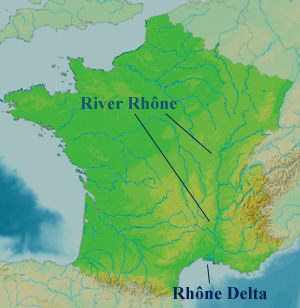





 Parc
Naturel Régional de Camargue. Website -
Parc
Naturel Régional de Camargue. Website - 


 Back
to: Aude département
Back
to: Aude département