 Historically,
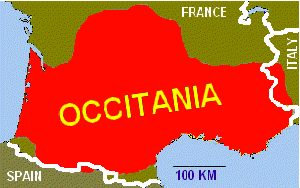
Occitan was spoken over a huge area - larger than the traditional
French speaking area. It had a number of dialects,
including Provençal.
Occitan is also closely related to the Catalan
language. Like "unofficial" languages elsewhere
in Europe, the use of Occitan was actively discouraged for
centuries in France, even suppressed.
In the interests of imposing an official language to help
bolster a nascent national identity. You may
still hear people refer to Occitan as a "patois"
a derogatory term for a unofficial language or dialect.
This term became common during the period of the French
Revolution - the result of a nasty little project led by
Abbé Grégoire for the elimination of "patois"
in France.
Historically,
Occitan was spoken over a huge area - larger than the traditional
French speaking area. It had a number of dialects,
including Provençal.
Occitan is also closely related to the Catalan
language. Like "unofficial" languages elsewhere
in Europe, the use of Occitan was actively discouraged for
centuries in France, even suppressed.
In the interests of imposing an official language to help
bolster a nascent national identity. You may
still hear people refer to Occitan as a "patois"
a derogatory term for a unofficial language or dialect.
This term became common during the period of the French
Revolution - the result of a nasty little project led by
Abbé Grégoire for the elimination of "patois"
in France.
To avoid confusion between the present Languedoc (part of the Languedoc-Roussillon Region) and the Languedoc (the area of the langue d'oc where Occitan was traditionally the first language), the latter area is often called Occitania.


 It
is easy now to underestimate the vitality and spread of
the language. It was for example the first (and
preferred) language of Richard I of England (the Lionheart),
as well as of his mother Eleanor
of Aquitaine. Occitan was the first literary
language of modern Europe, the language of the Troubadours.
The Occitan legacy of the Troubadours constitutes one of
the greatest literary treasures of Europe. To
appreciate the beauty of the language and the surprisingly
modern tone of their poetry, you might like to read a short
Troubadour
song, written by a Troubairitz
(a woman troubadour) over eight hundred years ago.
It
is easy now to underestimate the vitality and spread of
the language. It was for example the first (and
preferred) language of Richard I of England (the Lionheart),
as well as of his mother Eleanor
of Aquitaine. Occitan was the first literary
language of modern Europe, the language of the Troubadours.
The Occitan legacy of the Troubadours constitutes one of
the greatest literary treasures of Europe. To
appreciate the beauty of the language and the surprisingly
modern tone of their poetry, you might like to read a short
Troubadour
song, written by a Troubairitz
(a woman troubadour) over eight hundred years ago.
Eleanor's grandfather William IX of Aquitaine was the first known Troubadours. Click on the following link for songs (in Occitan with English translations) by William IX of Aquitaine 
Despite efforts by the French state to suppress Occitan, it still survives. Indeed, it has undergone a revival in the last few years, so you can learn a little about Occitan today.
See the menu at the bottom of this page for the Origins of Occitan, Occitan and Latin, Occitan and French, Occitan and Provençal, Occitan and Catalan, some Word Comparisons, Occitan Sayings, and the Suppression of Occitan.
|
The Church |
Road of the School |
The Square |
 |
 |
 |
 
|
Book Review
Grains of Gold - An Anthology of Occitan Literature,
This anthology is essential reading for anyone interested in Occitan literature, whether they know Occitan or not. A wide range of works are given in both Occitan and English translation. Occitan is more familiar to some under its old names - the Langue d'Oc and Provençal, and less well known under its medieval name the "Roman tongue" from which we derive our word "romance". Romantic love and romantic stories were both medieval inventions of the Occitan-speaking world. This compilation represents a broad sweep of historical Occitan, from the time of Guilhem IX (1086-1127), Duke of Aquitaine, right up to the twenty-first century. It includes works by Troubadours and Trobairitz (women troubadours); prose works including medieval chronicles, statutes, charters; and even Cathar rites. You will find works by all the best known troubadours, as well as works in Occitan and about Occitan by some unexpected writers including Dante, Rabelais, Nostradamus, John Locke, Simon Weil, and Ezra Pound. There are whole sections on the Felibridge movements, including one on Frédéric Mistral (who won the Nobel Prize for Literature in 1904 for his work in Occitan) and the Avignon Felibridge. The book has a good but all-too-short introduction, a useful bibliography, but no index, though this is compensated for by a detailed contents section. Highly recommended. |
|


The present Languedoc
represents the southern half of the area covered by
the ancient Roman's first province outside Italy. The northern
part is now called Provence,
and it's language, a dialect of Occitan, is known as Provençal.
For more on Provence and Provençal click on the following
link which will open a new window to Beyond
the French Riviera www.beyond.fr 
 Back
to: the Counts of Toulouse
Back
to: the Counts of Toulouse