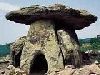
Dolmens, hypogeums and menhirs were built about 3500-2000 BC in a strip through modern France from Brittany to the coast of the Mediterranean Sea.
Broadly speaking Menhirs are single prehistoric standing stones. The word menhir is of Celtic origin men "stone" and hir "long". Dolmens are more complex structures, often roofed passageways. The name is Celtic: from dol "table" and men "stone". The term Megalith is more general, and derives from the Greek mega "Great" and lithos "stone".
Dolmens are prehistoric tombs. Menhirs are generally thought to be religious symbols for a prehistoric fertility cult. In some cases they may be merely limit stones between different tribal territories. As elsewhere in Europe, many have been vandalised by Christians.
These prehistory wonders are largely ignored by tourist guidebooks (and even by local road signs). Many of them are classified as Historic Monuments.
Megaliths in the Aude Départment: Spectacular menhirs include those at Counozouls (are 8, 90 metres ) and Morrel das Fadas (5 metres high). Notable dolmens include the Saint-Eugène (little Hill of Fairies) and Saint-Eugène, two biggest dolmens of the southern France (with lengths of between 15 and 25 metres). There are also many prehistoric stones around Rennes-les-Bains.
Megaliths in the Herault Départment:. Well worth seeing are the Menhirs at Ginestous and the Coste Rouge.
Megaliths in the Pyrénées-Orientales Départment:. Including Morrel das Fadas
 Back
to: Abbeys, Priories and Hermitages
Back
to: Abbeys, Priories and Hermitages