In principle, French village fêtes are similar to English village fêtes. In practice they are hardly recognisable as the same thing. There are no cake stalls, no games of cricket, no vicars, no tea, no dressing up in smart clothes. Here, village fêtes usually last for three days. During the hours of daylight nothing much happens, except perhaps a petanque (boules) tournament. Otherwise activity is confined to sitting in the shade drinking Ricard. At night the whole village comes alive. Selected villagers put on an open-air meal for all the inhabitants, setting up trestle tables in a convenient public place. In our village a road is closed off, a layer of sand is laid over the tarmac, and a large wood fire built on top to cook the food. An impromptu bar is opened next to the dining tables, and a local band starts up. The music is always a mixture: the latest French fashion for the youngsters; waltzes, tangos and foxtrots for the older generation; and a melange of French and Anglo-Saxon rock for everyone else. After the communal meal, the tables are cleared away and the music starts. Whatever is played, all age groups will soon be dancing together.
The typical village fête is held in late summer when the nights are still warm, and the crops and grapes have all been harvested. But the annual fête in Limoux, our nearest big town here in the Languedoc in the South of France, is different in almost every respect. For a start it lasts not three days, but over two months; and not in summer but mid winter. It is the earliest and longest fête in the French calendar, starting in January and continuing until two weeks before Easter Sunday. It is claimed that this fête has been held continuously since the middle ages. During revolutionary times an Arrêté of the Municipal Council dated February 1793 attempted to suppress it, but without success. No-one knows how it all originated. Some say it originally celebrated concessions made to the town by a nearby monastery during the Middle Ages. Others say that it was started by millers in the sixteenth century celebrating their successful trade with the kingdom of Aragon. Others link it with the local sparkling white wine called Blanquette de Limoux, an ancient wine that gave winegrowers in Champagne the idea for their product.

The earliest written record of the Limoux fête seems to be a regulation of 1604, but the truth is that the it has probably been evolving since well before medieval times, adopting new features over the centuries. At some stage it has been partially merged with the Christian Lent carnival, and with pierrot traditions. The introduction of women in 1972 was just the latest in a long history of evolutionary change.
The Limoux fête is generally called a Carnaval in French, but its real name is Fécos, the local name for its characteristic dances. It starts with a parade of the organising committee dressed up in comic masks, white baggy shirts and trousers, wearing red scarves and clogs, and carrying whips. These Meuniers (Millars) receive His Majesty, the King of the Carnival, a stuffed dummy, who will preside in a theoretical sort of way over the proceedings over the coming months. Each weekend there will be more parades in the main square, stopping at cafés to entertain and annoy the customers. Every Saturday and Sunday (and on Shrove Tuesday - Mardi Gras) a bande will make a number of outings in and around the town's main square. Each bande consists of a group of masked pierrots and their accompanying musicians who follow the pierrots from one café to another in the square, playing as they walk along, through a tunnel of spectators lining the ancient arcades.

Pierrots wear a sort of uniform, the forerunner of our modern clown outfit. Each bande has its own distinctive colours, often based on the traditional Limoux version: blackwith brilliant shiny bands. Pierrots wear a curious expressionless white mask. They each carry a long, flexible, decorated wand called a carabéna, and a large bag of confetti.
Pierrots dance rhythmically in time to the music, delicately moving their long springy wands over their heads. This rhythmic dance is the Fécos. In the old days flour and sweets were thrown around during the Fécos. Now confetti is used instead - seven tons of it each year. If you take photographs you will almost certainly receive a handful over your head, delivered with grace and panache when you least expect it.

The language of the Fécos, like the word Fécos itself, is Occitan, the traditional language of the area. Speeches are made and songs are sung in it. Nothing is sacred during the Fécos. Fun is poked at anything and anybody, from traditional local targets to national politicians and other figures in the news. Jokes and accusations that would offend in French seem to be accepted with good grace in Occitan, however risqué or slanderous. Some of the songs are traditional, some written specially for this year's festival. The musicians in each bande play a range of instruments: trumpets, trombones, clarinets, tubas and drums. They play from a selection of some eighty tunes, all in the local style, and not always easy for outsiders to tell apart. Some of them owe a recognisable debt to operas and operettas from the end of the 19th Century and beginning of the 20th.
![]()
Following the pierrots and the musicians come the goudils. They too are masked, and they too carry carabénas (those long springy wands) and bags of confetti. But their masks and costumes are different - different from the pierrots' and different from each other. Each has a distinctive character - an old man, a cartoon character, a harlequin, a fat woman, a local dignitary, a clown, the President of the USA. It is often difficult to determine the real sex of a goudil. There are few limits, either to their inventiveness or taste. Last year there was a masked Franciscan friar who would have been arrested for indecency in any other circumstances. These goudils stop and speak to people. Their conversations or chines also generally end in the distribution of confetti, but the goudils' confetti may well be slipped into shirts rather than scattered over heads.
The fécos is not just a spectacle, and those who witness it are not mere spectators. They are badauds, participants in the fécos with their own special name and their own special role. When they feel the sensuous caresses of a carabéna they become the centre of attention. The goudil on the other end of the carabéna will be expecting to exchange witty repartee. "Te counaissi" (I recognise you) says the goudil disguising his voice, after which he may say something funny, or perhaps not so funny. The badaud responds with as much wit as possible. If he recognises the goudil as well he will have won the exchange. |
|


![]()
The first outing starts at 11 am, generally inspired by a topical event, ribald or grotesque wherever possible. The 5 p.m. outing is slower and the costumes more traditional. The 10 p.m. outing is the most atmospheric with a even slower rhythm. It is lit by entorches. These are burning torches made using ancient techniques. They burn for a full 2 hours. By their light the pierrots process, slowly moving their carabénas and distributing confetti. It all makes a colourful spectacle. At first glance you might imagine it had all been invented for the benefit of tourists. But look closer, and you will find older, deeper elements. The pierrots dress with almost religious care. Every action is dictated by rules, some written, some passed down by word of mouth. For example pierrots must never remove their masques in public. They must wear "very fine" escarpins and gloves, and a cagoule under their masques. They must move slowly, dancing by moving only their arms and legs, not heads or bodies. They must lead the musicians. Only at their command will the music stop. There are always 14 musicians plus a meneur to lead them. Goudils must always remain behind the musicians. There are secrets too. Those entorches are made with resins according to a jealously preserved method, presumably dating from a time when people had their own recipes for such things.
Look a little closer still, and you will find yet older, darker elements. Chines for example are not always innocent fun. Anonymity allows things to be said that would otherwise remain unsaid. Those cagouls and masks, gloves and the disguised voices are important ways to help conceal a goudil's identity. Many a badaud has been caressed by a carabéna, looked into a mask, and heard a strange voice confide some dreadful or embarrassing truth about questionable business deals, illegal activities or private family matters. More than one baudil has heard the words "Te counaissi, es coucut" - "I know you: You're a cuckold".
On the last night of the last day of Carnival, the Sunday before Palm Sunday, a trial is held of the King of the Carnival. His Majesty, the straw mannequin, is defended vigorously but the prosecution wins the case and he is condemned to death. He is burned on a pyre in the centre of the main square, as the pierrots and goudils throw their carabénas into the flames: "Adiou paure canaval, tu t'en vas e iu demori jusqu'à l'annada que ven" (Goodbye poor Carnival, you go, and I remain until next year). Participants fall to their knees bewailing His Majesty's passing, then sing bawdy ditties about the coming Spring.
The annual Spring election and sacrifice of a king is well known to anthropologists. It is a popular theme found in many cultures around the world marking the passing of one year and the birth of the new. In Europe it often points to origins not in the Middle Ages but in prehistoric times. So the reason that the origins of the festival at Limoux seems so hazy is not that early written records have been lost. It is rather that the origins date back to a time before writing had been invented, a time when real people rather than straw effigies were sacrificed to help restore the sun and ensure a good harvest.
So if you want to see a Carnival that is not just put on for tourists, take a detour from your skiing holiday in the Pyrenees next Winter. After all the goudils are unlikely to know your embarrassing secrets.
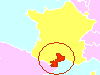
Limoux in is in the Aude Département in the Languedoc-Rousillon Région, half way between Carcassonne and the Spanish border, about an hour's drive from Andorra. The Limoux fécos lasts from January to the Sunday before Palm Sunday.
Contact: Limoux Tourist Office,
Tel: 33 (0)4 68 31 11 82,
Fax: 33 (0)4 68 31 87 14