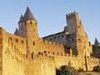
 Narbonne
is located in the Aude
département, roughly 8 miles from the the
Gulf of Lion (Mediterranean Sea), due east of Carcassonne.
Narbonne
is located in the Aude
département, roughly 8 miles from the the
Gulf of Lion (Mediterranean Sea), due east of Carcassonne.
The earliest settlement here was an oppidum (a defended Iron Age village) at Montlaurès, about 4km north-west of the present city. Narbonne was the site of the first Roman settlement beyond the Alps in Gaul, called Narbo Martius (Narbo), founded in 118 BC.
Narbo Martius, the Roman colony soon became the wealthiest city in southern Gaul, and was nominated by the emperor Augustus as capital of a province stretching from Toulouse to Geneva: Gallia Narbonnensis.
|
It was already a wine growing region. In AD92, under pressure from Roman winemakers, the emperor Domitian ordered that half of the vineyards here should be torn up. Narbonne became the capital of the whole of Southern Gaul. It lay on the Domitian Way (Via Domitia). At the time it was a major port, although it now lies some 20 km from the sea. Narbonne was taken by the Visigoths in 413. Later they made it their regional capital. In 719 the Moors (Saracens) captured the town and hung on to it until 759 when the city had become part of the Frankish kingdom under Charlemagne's father, Pépin the Short. During the Middle Ages, the southern part of the town was ruled by the The Counts of Toulouse as Dukes of Narbonne; the northern part was under Episcopal administration. In Occitan the name Narbo became Narbonna and the Franks turned this into Narbonne. In the 11th and 12th centuries Narbonne was the centre of an important Jewish exegetical school, which played a role in the growth and development of the Zarphatic (Judæo-French) and Shuadit (Judæo-Provençal) languages. The Kabbalah was rediscovered and developed here. Jews had settled in Narbonne from about the 5th century, with a community that had grown to around 2000 in the 12th century. Narbonne was frequently mentioned in Talmudic works in connection with its scholars. Abraham ibn Daud of Toledo, attributes to them an importance comparable to the exilarchs of Babylon. |
|

|
Narbonne saw a period of peace and prosperity in the 13th century. The Gothic cathedral was begun in 1272 and work continued on and off until a lawsuit in 1347 put a stop to it. Part of the city wall needed to be demolished to make way for the enlarged nave, and the city council objected. The council was soon proved right. The ramparts were necessary to the city's safety during the Hundred Years' War. The cathedral still remains unfinished. Narbonne, originally a trade port, survived as a major fishing port until the early 14th century. Flooding in 1320 caused the harbour to silt up, and the River Aude changed course so that the port of Narbonne became a backwater. That is why it is now lies on a vine-growing plain, 8 miles (13km) inland.
|

|
 In
1348 the Black Death struck the Languedoc as it spead across
Europe through Italian trade routes. Around 40% of the population
died. As in other cities, local Christian leaders invented
stories that the disease was caused by infected well water
and that wells had been poisoned by Jews. As in Carcassonne
and other cities, surviving members of the local Jewish
community were burned alive for these imaginary crimes.
In
1348 the Black Death struck the Languedoc as it spead across
Europe through Italian trade routes. Around 40% of the population
died. As in other cities, local Christian leaders invented
stories that the disease was caused by infected well water
and that wells had been poisoned by Jews. As in Carcassonne
and other cities, surviving members of the local Jewish
community were burned alive for these imaginary crimes.
The Hundred Years' War added to Narbonne's misery and by the late 14th century, Narbonne was much reduced.
In 1507, Narbonne became part of France.
Paul Riquet, the visionary architect of the Canal du Midi, attempted to revive Narbonne's fortunes in the 17th century by constructing the Canal de la Robine to connect it to the Canal du Midi. His efforts were frustrated by hostile dignitaries from nearby towns, so the work was not completed until 1786.
|
Narbonne's status today is considerably reduced (it is not even the capital of the Aude département in which it lies. (Carcassonne is capital of the Aude department). Narbonne is still an important road and rail junction: it announces itself as 'Narbonne: Cross-roads of Southern Europe'. The A61 and A9 motorways meet here, as do main railway lines: one running south from Bordeaux and the other east-west along the Mediterranean Coast from Italy through to Spain. Now, thanks largely to the wine and tourist trades, the construction of the railway, and some light industry, Narbonne is thriving again. There is much to enjoy here. The city has a slightly larger population than Carcassonne, but is less hectic and crowded, and both the coast and the Corbières are easily accessible. The centre of Narbonne, bisected by the Canal de la Robine, is an attractive place for shopping and sightseeing. A good place to head for is the Halles (covered market) by the bank of the canal. This award-winning food market is said to be one of the best in France. Open from 6 am until 1 pm daily, the market overflows with local produce. On Thursdays there is also an open-air market stretching along the canal bank near the Halles, with flower and clothes stalls, among others. The canal itself is lined with waterside cafés. |
|

|
Car Hire in Narbonne
|
|
There are plenty of restaurants in Narbonne. There is also a modern cinema, by the canal a short distance from the Halles, and a theatre in the Avenue Domitius to the east. You can swim at the futuristic Espace de la Liberté, opened in 1989 to commemorate the bicentenary of the French revolution. It has an Olympic-sized indoor pool with waterslides, a smaller paddling pool for children, and an outdoor pool. You can also ice-skate and play ten-pin bowling here. Things to see include: |
|
||||||||||


|
Cathedral. The medieval Cathedral of Saint-Just with its 40m-high apse and choir making it the third tallest Gothic structure in France. The reredos, which had been hidden for 250 years, was restored and put on display in March 2000. You can climb the 251 steps of the north tower for a view over the rooftops of Narbonne. On a clear day you can see the Pic du Canigou in the Pyrenees from here. The Cathedral treasury contains two fine Flemish tapestries of the early 16th century. (More below) The Basilique de St. Paul, the oldest Christian building in Gaul, is also worth a visit. Palais des Archêveques (Archbishop's palace). Three square towers of the fortified Palais date from the 13th and 14th centuries. The Gothic-style town hall was added to the palace in the 19th century. The building now houses two museums containing collections of Roman artefacts, paintings, and ceramics. Roman ruins. Including L'Horreum the only extant Roman building. . Roman underground merchants' warehouses. |
 |
| Basilica of Saint-Paul-Serge. Mainly
12th century. An example of southern French early Gothic
architecture.
Archaeological Museums. The Musée Archéologique is housed in the Archbishop's Palace, restored by Eugène Viollet-le-Duc, the architect responsible for the restoration of the fortifications of Carcassonne. The museum has a large collection of statuary, pottery, and examples of Roman wall paintings and mosaics from excavations in the city. |

|
| Musée Lapidaire. Stone Museum
- an impressive collection of Roman stones from around
Narbonne, housed in an empty church.
The Musée d'Art et d'Histoire, next door to the Archaeological Museum, has a collection which includes Dutch, Flemish and Italian paintings, and some 18th century French painted ceramics. Via Domitia. Recently, work in the Place de l'Hôtel de Ville, the main square, uncovered part of the Roman road, the Domitian Way (Via Domitia). This has been conserved and is now open to view. La Poudrerie, a 17th-century powder house, has been converted into a museum of winemaking. A pleasant way to see the surrounding countryside is to take a cruise along the canal, either to the coast (at Port-la-Nouvelle), or inland (to Le Somail on the Canal du Midi. You can join a boat which leaves from the Pont des Marchands; originally a Roman bridge carrying the Via Domitia into the port, it is now lined with medieval buildings housing small shops. For more information, visit the tourist office in the Place Salengro, behind the cathedral (Tel. 04 68 65 15 60; fax 04 68 65 59 12). |
|

 Narbonne
lies on the Canal
de la Robine, an extension to the Canal du Midi, built
by Pierre-Paul
Riquet a notable
Languedoc resident. The Canal is popular for boating
holidays and through France's
extensive canal network provides a way to get to the
Languedoc from the Atlantic Ocean, Northern France and Mediterranean
Sea.
Narbonne
lies on the Canal
de la Robine, an extension to the Canal du Midi, built
by Pierre-Paul
Riquet a notable
Languedoc resident. The Canal is popular for boating
holidays and through France's
extensive canal network provides a way to get to the
Languedoc from the Atlantic Ocean, Northern France and Mediterranean
Sea.
Cathédrale Saint-Just-et-Saint-Pasteur de Narbonne
 Narbonne
Cathedral, more properly the Cathédrale Saint-Just-et-Saint-Pasteur
de Narbonne, is a former cathedral, and national monument
of France, located in Narbonne. It is dedicated to saints
known in English as Justus and Pastor.
Narbonne
Cathedral, more properly the Cathédrale Saint-Just-et-Saint-Pasteur
de Narbonne, is a former cathedral, and national monument
of France, located in Narbonne. It is dedicated to saints
known in English as Justus and Pastor.
It was the seat of the Archbishop of Narbonne until the Archbishopric was merged into the Diocese of Carcassonne under the Concordat of 1801. The title, however, passed to the Archbishop of Toulouse. The church was declared a basilica minor in 1886.
The building, begun in 1272, is noted for being unfinished.
The cathedral is situated in the heart of the present city of Narbonne,. In the Middle Ages was located by the city wall. In 313, just after the edict that authorized Christianity as a legal religion, a Constantinian basilica was erected on approximately the same spot as the present cathedral.
 Ruined
by a fire in 441, it took 37 years to demolish those parts
of the basilica that had escaped destruction. Then a Latin
basilica was constructed by Bishop Rusticus, who was encouraged
in his work by the Gaulish prefect, Marcellus. The basilica
was finished on November 29, 445. Originally dedicated to
the fictitious martyr Saint Genesius of Arles. It was re-dedicated
in 782 to the equally fictitious Spanish child martyrs Saints
Justus and Pastor.
Ruined
by a fire in 441, it took 37 years to demolish those parts
of the basilica that had escaped destruction. Then a Latin
basilica was constructed by Bishop Rusticus, who was encouraged
in his work by the Gaulish prefect, Marcellus. The basilica
was finished on November 29, 445. Originally dedicated to
the fictitious martyr Saint Genesius of Arles. It was re-dedicated
in 782 to the equally fictitious Spanish child martyrs Saints
Justus and Pastor.
Little remains of this building: two Roman columns from the former forum, used in the nave, can now be seen in the present cloister; the lintel and an aedicule of white marble can now be seen in the Lapidary Museum of Narbonne.
A Carolingian cathedral was erected in 890 by Archbishop Theodard (d. 893). Its steeple, largely restored, is visible from the cloister. Despite help given to it by three popes, this church fell into ruin.
The idea to build a Gothic cathedral was a political decision made in 1268 by Pope Clement IV, the former archbishop of Narbonne. He wanted a monument made in the magnificent style of the (then nearby) Kingdom of France.
Construction of the new cathedral was supposed to begin in 1264, but did not actually start until 1272. The choir was finished in 1332, but the rest of the building was never completed, as the result of many factors including changes in the economic status of Narbonne, its unusual size and geographical location and financial constraints. Also to complete it would have meant demolishing the city wall.
The diagram on the right is a plan by Viollet-le-Duc, showing in black the actual structure and in grey his suggestion of some of the nave that was never built
Narbonne Photogallery
|
Narbonne at Christmas |
 |
|
Narbonne at Christmas |
 |
|
Narbonne at Christmas |
 |
|
Cloister of Narbonne Cathedral |
 |
|
Narbonne at Christmas |
 |
|
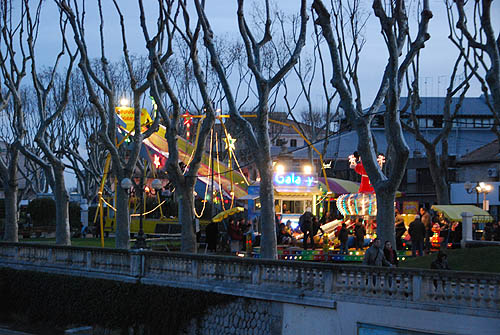
Narbonne at Christmas |
 |
|
Canal de la Robine, Narbonne |
 |
|
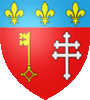
Coat of arms of trhe City of Narbonne.
|
 |
|
Narbonne |
 |
|
Narbonne at Christmas |
 |
|
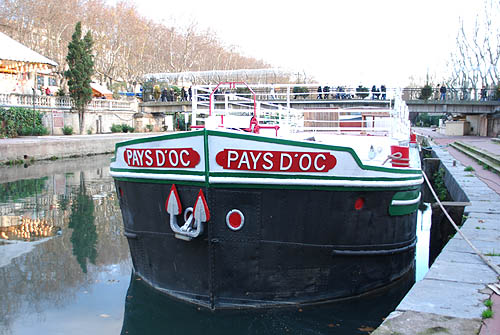
Canal de la Robine, Narbonne |
 |
|
Narbonne |
 |
 Back
to: Pyrénées—Orientales département
Back
to: Pyrénées—Orientales département