Nīmes is the capital of the Gard Département. It lies south-southwest
of Lyon, at the foot of barren hills (the Monts Garrigues)
to the north and west of the city. It is stands upon a vine
growing plain, in the
Cévennes
area extending to the south and east. Between Provence, the
Camargue and the Cévennes mountains, this is the heart
of Roman France.
The city was named after Nemausus, the genie of a sacred
fountain. The capital of a Gaulish tribe, it was annexed
in 121 BC to Rome. The emperor Augustus founded a new city
here, giving it privileges that allowed it to prosper. The
town became one of the richest in Gaul during its Roman
period.

 The
city’s coat of arms shows a crocodile chained to a
palm tree - the device dates back to Roman times and commemorates
the defeat of Mark Anthony on the Nile by the Emperor Augustus.
The connection is that Augustus rewarded his legionaries
with grants of land in the Roman colony here.
The
city’s coat of arms shows a crocodile chained to a
palm tree - the device dates back to Roman times and commemorates
the defeat of Mark Anthony on the Nile by the Emperor Augustus.
The connection is that Augustus rewarded his legionaries
with grants of land in the Roman colony here.
 The
city was plundered by the Germanic Vandals in the 5th century.
Later it was occupied by the Moors (Saracens], who were
driven out in 737. The town was acquired by the counts of
Toulouse in the 10th century. In 1229 it was annexed to
France.
The
city was plundered by the Germanic Vandals in the 5th century.
Later it was occupied by the Moors (Saracens], who were
driven out in 737. The town was acquired by the counts of
Toulouse in the 10th century. In 1229 it was annexed to
France.

 In
the Middle Ages wool and silk industries brought wealth
to the city. It was here that a particularly adaptable type
of serge material originated. Serge “De Nîmes”,
hence denim, found its way to America in 1870.
In
the Middle Ages wool and silk industries brought wealth
to the city. It was here that a particularly adaptable type
of serge material originated. Serge “De Nîmes”,
hence denim, found its way to America in 1870.
During the Reformation Nīmes became largely Protestant.
In 1598, the Edict of Nantes conferred upon French Protestants
a degree of religious freedom. After the Edict was revoked
in 1685 the city suffered once again from persecution.
Jean Auguste Robert, a communist militant, was executed
by guillotine at Nîmes on April 22nd 1943 during the
Second World War. On the same day Vinicio Faïta another
communist militant and antifascist, was also guillotine
here. Resistance Companies were named after them: Compagnie
430 became Maquis Jean Robert and Compagnie
4307 became Maquis Faïta.
 Nīmes
is known for its Roman remains, most of which are in an
excellent state of preservation.
Nīmes
is known for its Roman remains, most of which are in an
excellent state of preservation.
Some
things worth seeing are listed below:
 Les
Arènes (an amphitheatre). The amphitheatre
is one of the best preserved Roman amphitheatres in existence.
It was probably built in the 1st century AD, possibly
around 1 AD. It has an elliptical configuration measuring
440 by 330 feet and 69 feet high and built of large stones
from a nearby quarry, put together without mortar. It
sat around 24,000 spectators. Its exterior has a double
row of 60 arches surmounted by an attic. It was originally
constructed for gladiatorial shows, chariot races, and
naval spectacles. In the 5th century, it was used as a
fortress by the Visigoths. In the Middle Ages houses and
a church were built inside it. In 1809 it was cleared
of buildings and is now used for coridas (bloodless bullfights).
It is used all year round since the installation of a
removable roof - a recent century replacement of the original
Roman awnings.
Les
Arènes (an amphitheatre). The amphitheatre
is one of the best preserved Roman amphitheatres in existence.
It was probably built in the 1st century AD, possibly
around 1 AD. It has an elliptical configuration measuring
440 by 330 feet and 69 feet high and built of large stones
from a nearby quarry, put together without mortar. It
sat around 24,000 spectators. Its exterior has a double
row of 60 arches surmounted by an attic. It was originally
constructed for gladiatorial shows, chariot races, and
naval spectacles. In the 5th century, it was used as a
fortress by the Visigoths. In the Middle Ages houses and
a church were built inside it. In 1809 it was cleared
of buildings and is now used for coridas (bloodless bullfights).
It is used all year round since the installation of a
removable roof - a recent century replacement of the original
Roman awnings.
 La
Maison Carrée (literally The Square House.
The famous Maison Carrée, a temple, was built in a Greek
style during the 1st century AD as . It is a rectangular
structure measuring 82 feet long by 40 feet wide. It now
houses a museum of Roman sculpture. It was originally
dedicated to Gaius and Lucius Caesar, the adopted sons
of the emperor Augustus. It is one of the most beautiful
monuments built by the Romans in Gaul, and certainly the
best preserved, despite having been used, over the years,
as a stable, a church, a town hall, and a museum. It now
houses a collection of Roman sculptures.
La
Maison Carrée (literally The Square House.
The famous Maison Carrée, a temple, was built in a Greek
style during the 1st century AD as . It is a rectangular
structure measuring 82 feet long by 40 feet wide. It now
houses a museum of Roman sculpture. It was originally
dedicated to Gaius and Lucius Caesar, the adopted sons
of the emperor Augustus. It is one of the most beautiful
monuments built by the Romans in Gaul, and certainly the
best preserved, despite having been used, over the years,
as a stable, a church, a town hall, and a museum. It now
houses a collection of Roman sculptures.
In medieval times it was vandalised, like
so many other ancient monuments, by the Church. In the
11th century a chapel was added to the North facade. The
Maison Carrée itself was used as a town hall for
the consuls of the town. The chapel was destroyed during
the Wars of Religion. The maison was sold and converted
into private residences and a stable. Augustinian monks
bought it in 1673. An Augustinian convent was built onto
it to the West, possibly to Christianise it. Fortunately
the local authorities prevented them from completely destroying
it and they had to be content with setting up a church
inside the cella, and digging a cemetery under the building.
In 1789 it was expropriated by the Revolutionary government,
used as a granary and then sold off as a "bien national".
During the nineteenth century it was used by the Prefecture
du Gard, then it served as a repository for archives,
and then became a museum in 1823. A large theatre was
built to the west of the Maison Carrée. All this
was cleared away in the twentieth century and the building
was converted into a public library and museum of contemporary
art.
|
|
|
|
 |
|
 |
The Romans were careful in their selection
of stone. The podium and stairs are made of limestone
from the local Roquemaillère quarry while the slabs
of the stylobate are made of stone from the local Barutel
quarry on the road to Arlès. A softer stone was
needed for the carvings on the capitals, frieze, columns,
bases, architraves and cornices. For this the Romans had
to bring stone from Bois de Lens about 12 miles away.
Another stone, soft limestone from Sernhac and Beaucaire,
was used for the internal walls and substructure.
The Tour Magne is an octagonal tower dating (probably)
from the 1st century BC, once part of the Roman fortifications.
It is on top of a hill just outside the city, and is the
city's oldest Roman building. It is 92 ft high, probably
taller originally. From it you get a panoramic view of
the city and its surroundings. Its precise function is
not known. It was incorporated into the Roman wall in
16 BC.
Reservoir.
Not far from the Tour Magne is a reservoir. This was the source of the water carried
by the great Pont du Gard Roman aqueduct. Water was distributed throughout the
town.
Jardin de la Fontaine. Located
on the edge of the city is Jardin de la Fontaine, which was designed in 1745.
The fountain, and the canals that flow through it, are partly Roman.
 The
Archeological Museum, which is housed in a former Jesuit college, has a fine
collection of Roman objects, as well as some Iron Age artifacts.
The
Archeological Museum, which is housed in a former Jesuit college, has a fine
collection of Roman objects, as well as some Iron Age artifacts.
Cathedral. The llth century Cathedral of Saint Castor.
Museums
of fine art and local history are both worth a visit. Exhibitions take place at
the “Carré d’Art” Museum of Contemporary Art, a structure
of glass and steel designed by Sir Norman Foster (Now Lord Foster). It overlooks
the site of the old Roman forum.
Porte d'Auguste. It it is through
this gate that the Via
Domitia entered Nîmes from the East. The central passageways were for
chariots, the smaller side one for pedestrians.
The house where Alphonse Daudet was born.
The Feria is a 5-day Whitsuntide carnival with a strong
southern accent - paella and flamenco - colourful traditional
costumes, with gardians from the
Camargue with their famous black bulls and white horses.
Throughout the summer, markets are held on Thursday nights,
when stalls selling crafts, painting and local products.
Car Hire from Nīmes and Nīmes Airport
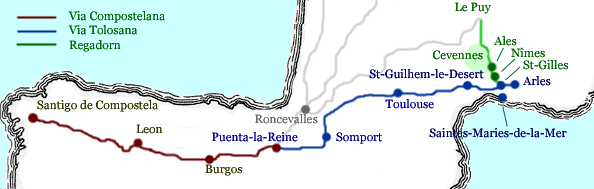 An important pilgrim route, the Via Tolosana (marked in blue on the right) led through Arles, St-Gilles, Saint-Guilhem-le-Désert and Toulouse and crossed the Pyrenees to join other routes at Puenta-la-Reina, thence to Santiago along the Via Compostelana to Santiago de Compostela.
|
Another route, the Regordane (marked in green), led
from Le Puy-en-Velay to St-Gilles,
by way of the
Cévennes, Alès
and Nîmes. Some pilgrims came only as far as
St-Gilles,
the fourth most important pilgrimage destination in
Europe. Others went on to Santiago de Compostela along
the Via Tolosana possibly taking a detour to Saintes-Maries-de-la-Mer
(While Compostela claimed the relics of St-James,
Saintes-Maries-de-la-Mer claimed the relics of his
mother, Mary)
|
|
Pilgrims and hikers
still walk these ancient pilgrimage routes. Click
on the following external link for more information
on walking the Regordane
 |
|
 Local Activities:
Nimes
Campagne Golf (Golf de Nîmes Campagne) 
Nimes
Vacquerolles Golf Club (Golf De Nimes Vacquerolles)
Golf
Club d'Uzès (Uzès Golf Club)
Massane
Golf Club Golf Club (Domaine de Massane Golf Club, 40 km away)
The
traditional manufacture of clothing and textiles still flourishes here.
From the UK, you can travel to Nîmes by Eurostar
and theTGV
|
|
|

Grand Prix Automobile Nimes Giclee Print
Ham, George
|
|

Poster Advertising Nimes, the French Rome, circa
1930 Giclee Print
Robert, Hubert
|
|
|

Musee des Beaux-Arts Nimes Art Print
Bezombes, Roger
|
|

Exterior of Roman Amphitheatre,
Arenes, Nimes, France Photographic Print
Gottschalk,...
|
|
|

Thermae and Nymphaeum of Nimes, 1838 Giclee
Print
Questel
|
|
|
|
|

Grand Prix de Nimes, 1932 Giclee Print
|
|


 Back to last page: Cities